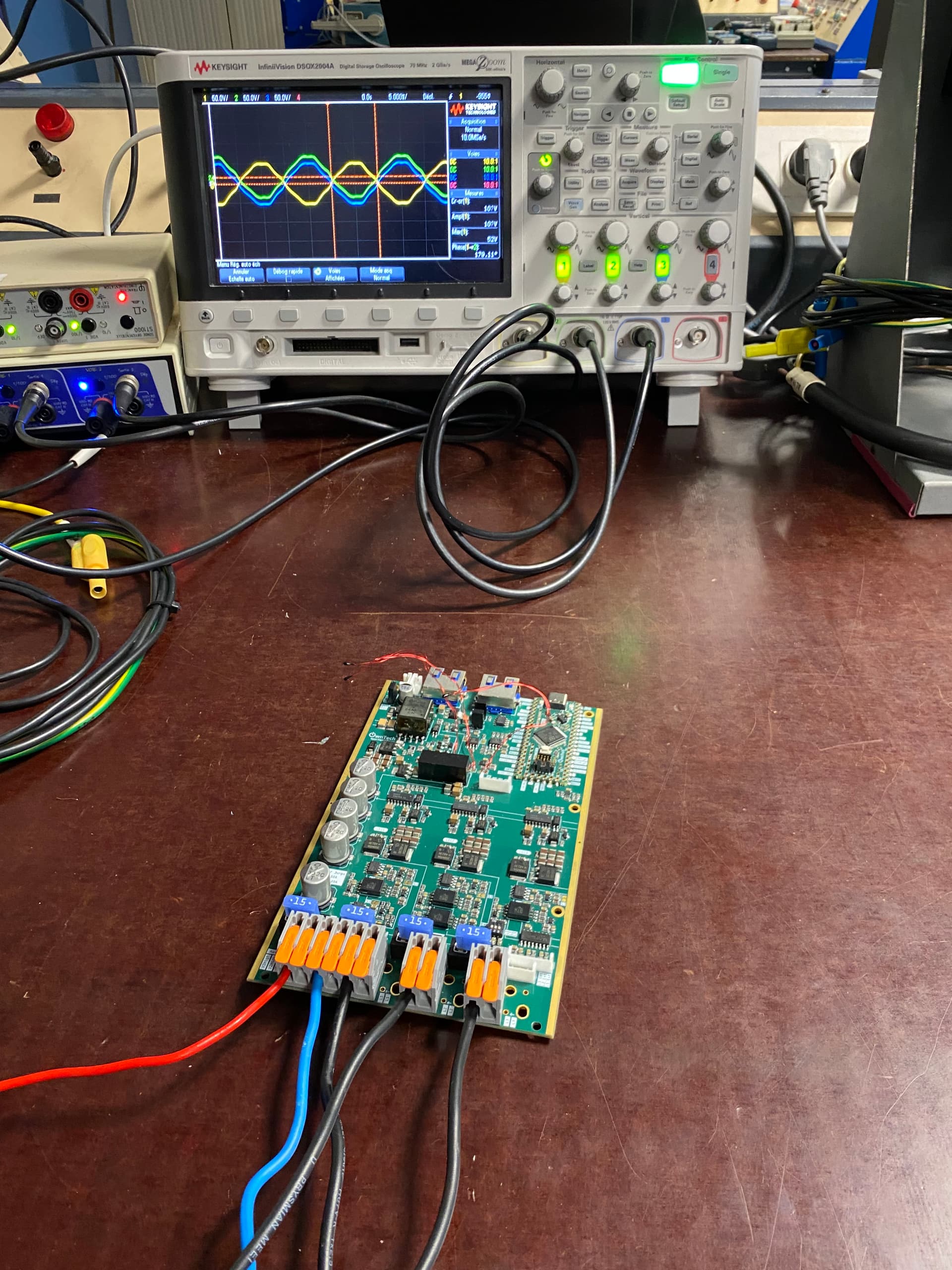
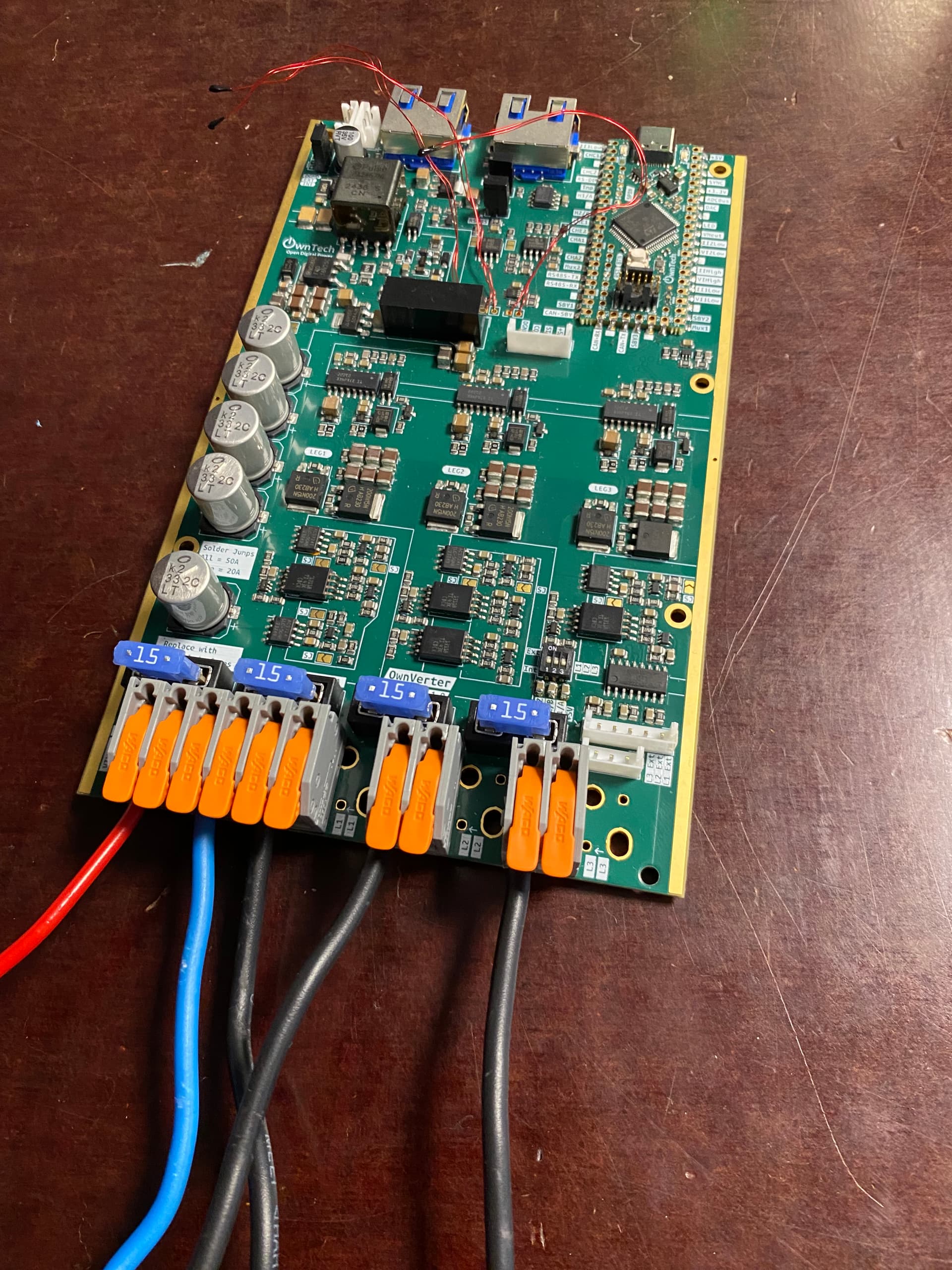
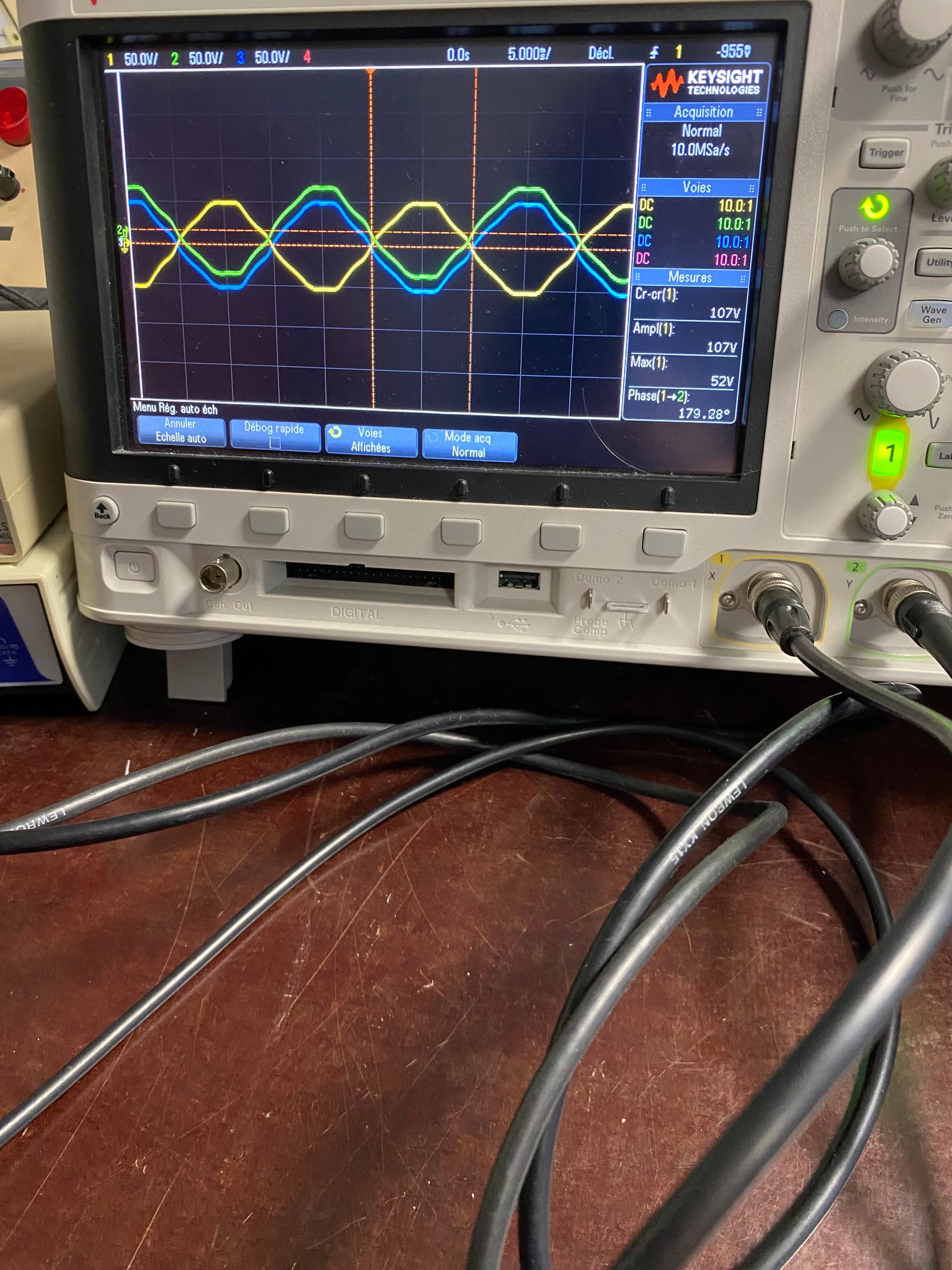
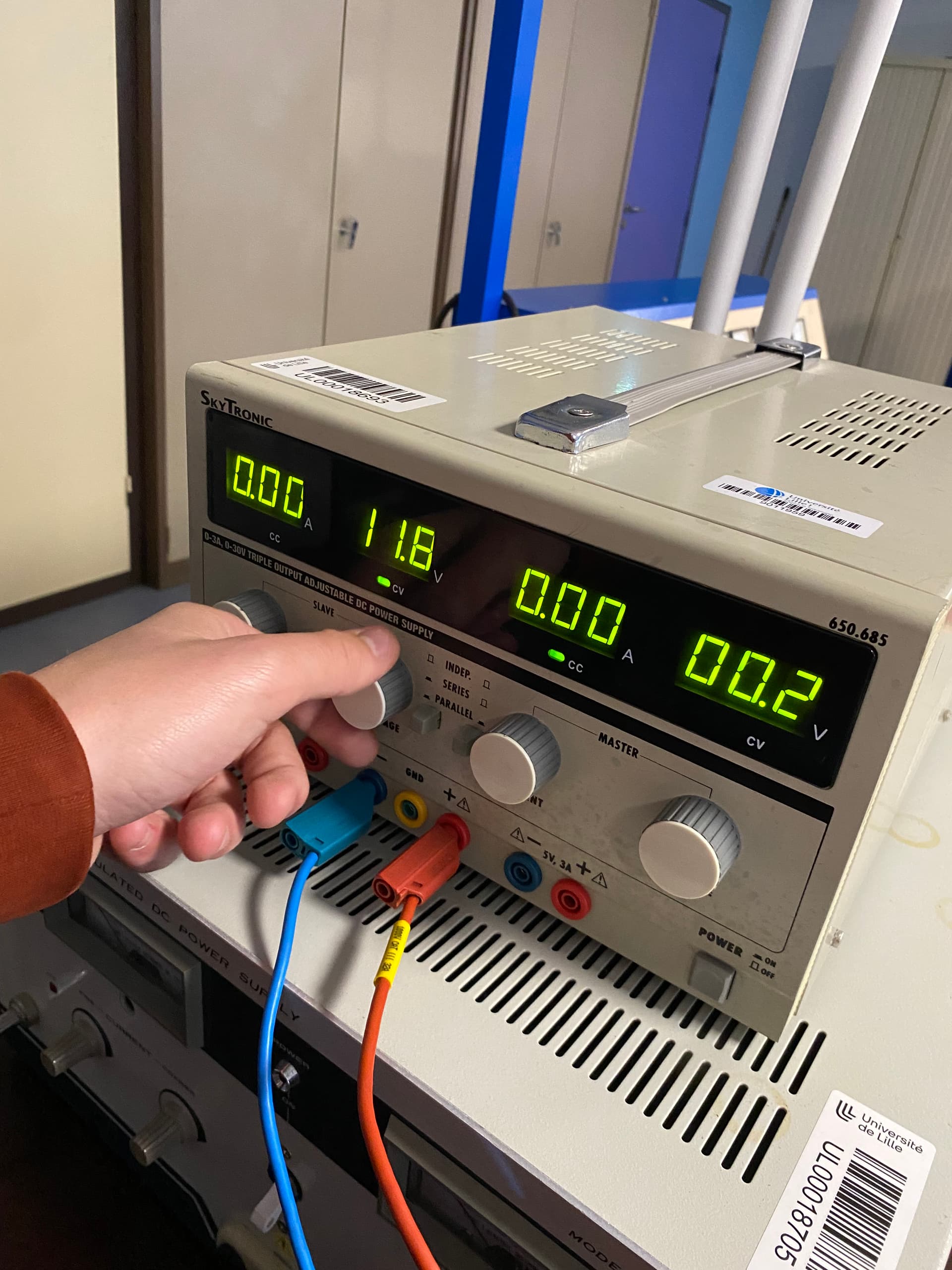
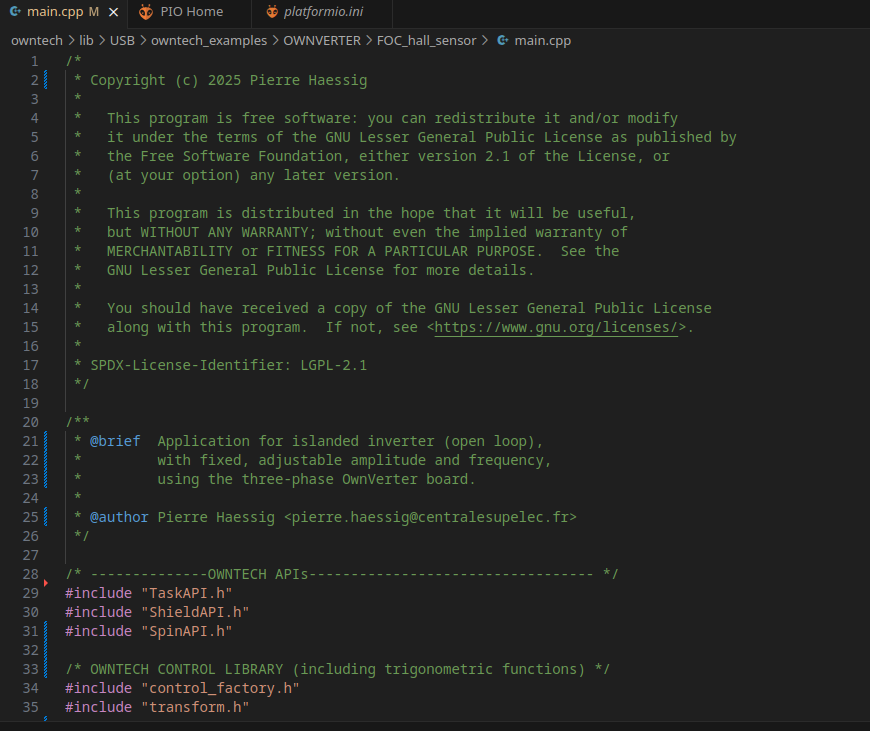
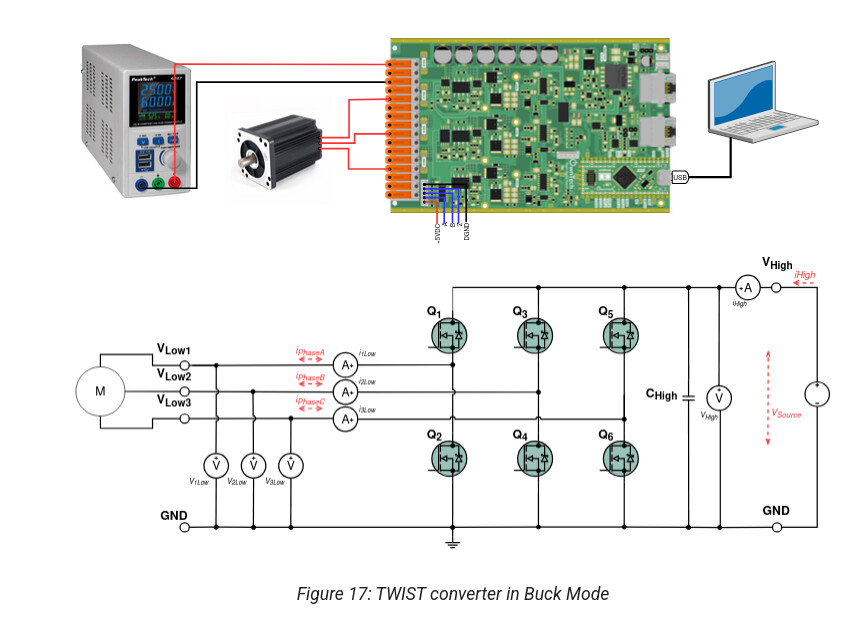
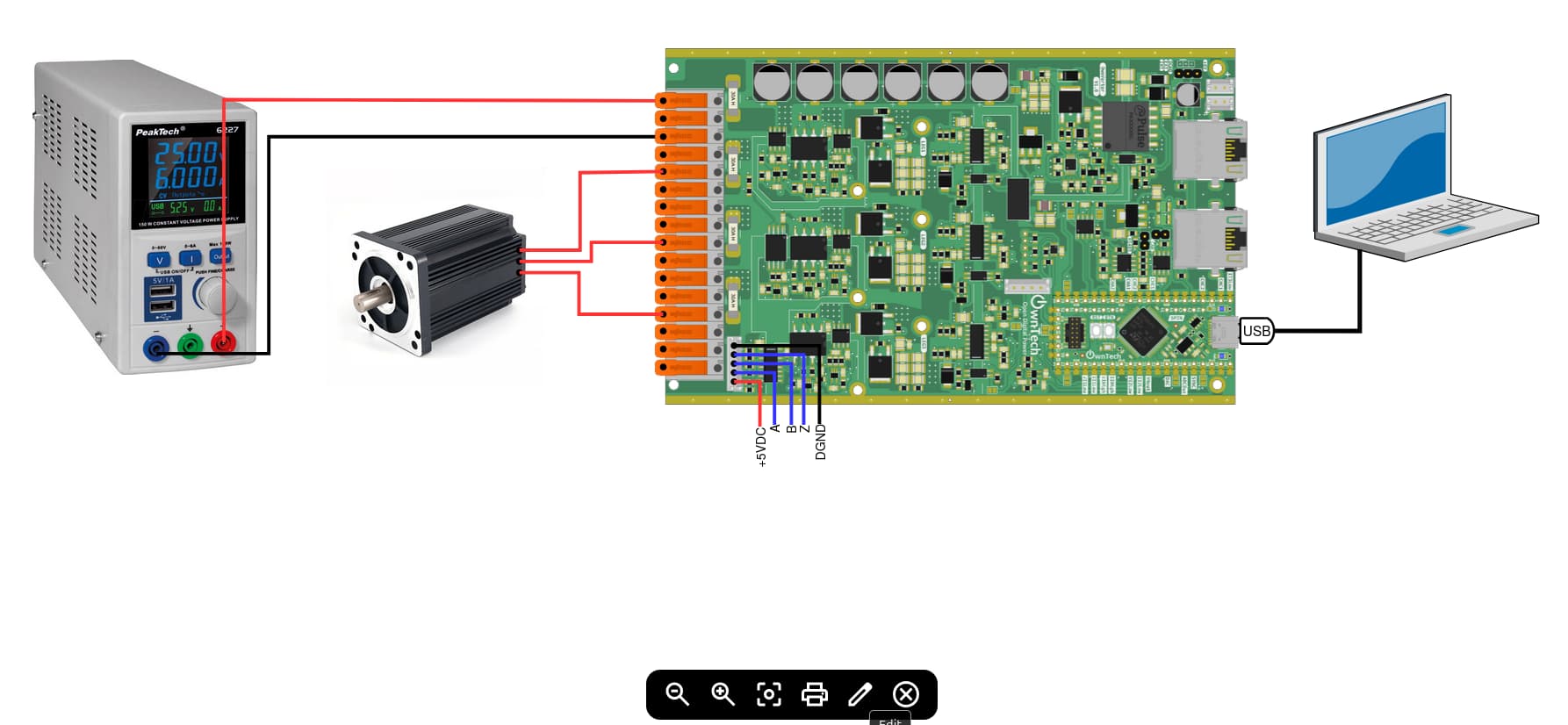
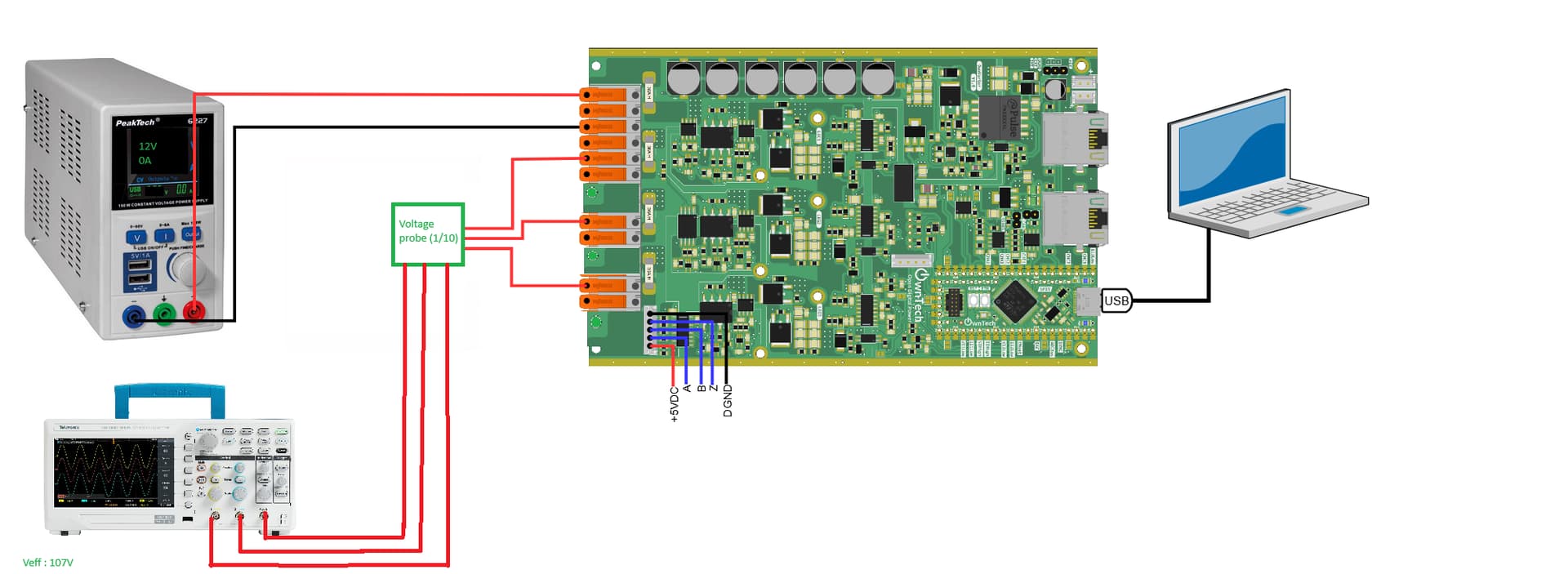
Hello ! Thank you for your response. Here’s our scematic connexion and our main.cpp
And the main.cpp :
/\*

* Copyright (c) 2024-present LAAS-CNRS
*
* This program is free software: you can redistribute it and/or modify
* it under the terms of the GNU Lesser General Public License as published by
* the Free Software Foundation, either version 2.1 of the License, or
* (at your option) any later version.
*
* This program is distributed in the hope that it will be useful,
* but WITHOUT ANY WARRANTY; without even the implied warranty of
* MERCHANTABILITY or FITNESS FOR A PARTICULAR PURPOSE.  See the
* GNU Lesser General Public License for more details.
*
* You should have received a copy of the GNU Lesser General Public License
* along with this program.  If not, see <https://www.gnu.org/licenses/>.
*
* SPDX-License-Identifier: LGPL-2.1
  \*/

/\*\*

* @briefbrief  This file is an example of a Field Oriented Control for
*
      OwnTech OwnVerter board.

*
      Please check example documentation to get more details

*
      how to use this example: https://docs.owntech.org/examples/

* @author
* @author Régis Ruelland <regis.ruelland@>@author<aas.fr>
* @author Jean Alinei <[email protected]>
  \*/

/\* --------------OWNTECH APIs---------------------------------- \*/

#include “ScopeMimicry.h”
#include “SpinAPI.h”
#include “TaskAPI.h”
#include “ShieldAPI.h”
#include “arm_math_types.h”
#include “control_factory.h”
#include “transform.h”
#include “trigo.h”
#include “zephyr/console/console.h”

/\* --------------SETUP FUNCTIONS DECLARATION------------------- \*/

/\* Setups the hardware and software of the system \*/
void setup_routine();

/\* --------------LOOP FUNCTIONS DECLARATION-------------------- \*/

/\* Code to be executed in the background task */
void loop_background_task();
/* Code to be executed in real time in the critical \*/
void loop_critical_task();
void application_task();

/\* --------------USER VARIABLES DECLARATIONS------------------- \*/
#define HALL1 PC6
#define HALL2 PC7
#define HALL3 PD2

static const float32_t AC_CURRENT_LIMIT = 3.0;
static const float32_t DC_CURRENT_LIMIT = 2.0;

/\* Used in the control algorithm */
static const float32_t MIN_DC_VOLTAGE = 30.0F;
/* Used as a threshold to start POWER mode \*/
static const float32_t V_HIGH_MIN = 5.0;
static const float32_t Ts = 100.e-6F;
static const uint32_t control_task_period = (uint32_t)(Ts \* 1.e6F);

/\* Hall effect sensors \*/
static uint8_t HALL1_value;
static uint8_t HALL2_value;
static uint8_t HALL3_value;

static uint8_t angle_index;
static float32_t hall_angle;
static PllAngle pllangle = controlLibFactory.pllAngle(Ts, 10.0F, 0.04F);
static PllDatas pllDatas;
static float32_t angle_filtered;
static float32_t w_meas;

/\*

* One sector for one index value
* Index = H1*2^0 + H2*2^1 + H3\*2^2
  \*/
  static int16_t sector[ ] = {-1, 5, 1, 0, 3, 4, 2};
  static float32_t k_angle_offset = 0.0F;

/\* Power LEG measures \*/
static float32_t meas_data;
static float32_t I1_low_value;
static float32_t I2_low_value;
static float32_t I1_offset;
static float32_t I2_offset;
static float32_t tmpI1_offset;
static float32_t tmpI2_offset;
static const float32_t NB_OFFSET = 2000.0;
static float32_t V1_low_value;
static float32_t V2_low_value;
static float32_t V12_value;

/\* DC measures \*/
static float32_t I_high;
static float32_t V_high;

/\* Three phase system and Park DQ Frame (dqo) \*/
static three_phase_t Vabc;
static three_phase_t duty_abc;
static three_phase_t Iabc;
static dqo_t Vdq;
static dqo_t Idq;
static dqo_t Idq_ref;
static float32_t angle_4_control;

/\* Variables used to get static value for ScopeMimicry \*/
static three_phase_t Iabc_ref;
static float32_t duty_a, duty_b;
static float32_t Ia_ref;
static float32_t Ib_ref;
static float32_t Va;
static float32_t Iq_meas;
static float32_t Iq_ref;
static float32_t Iq_max;
static float32_t Vd, Vq;
static float32_t HALL1_value_f;
static float32_t HALL2_value_f;
static float32_t HALL3_value_f;
static float32_t angle_index_f;

/\* We only make torque control. \*/
static float32_t manual_Iq_ref;

/\*\*

* Low Pass Filters Init
  \*/
  static LowPassFirstOrderFilter vHigh_filter =
  controlLibFactory.lowpassfilter(Ts, 5.0e-3F);

static LowPassFirstOrderFilter w_mes_filter =
controlLibFactory.lowpassfilter(Ts, 5.0e-3F);

static float32_t V_high_filtered;
static float32_t inverse_Vhigh;

/\*\*

* PID
  \*/

static float32_t Kp = 30 \* 0.035;
static float32_t Ti = 0.002029;
static float32_t Td = 0.0F;
static float32_t N = 1.0;
/\* Coefficient 0.4 comes from Va_max =  (α\_max - 0.5) \* Udc     \*/
static float32_t lower_bound = -MIN_DC_VOLTAGE \* 0.4;
static float32_t upper_bound = MIN_DC_VOLTAGE \* 0.4;
static Pid pi_d = controlLibFactory.pid(Ts, Kp, Ti, Td, N,
lower_bound, upper_bound);

static Pid pi_q = controlLibFactory.pid(Ts, Kp, Ti, Td, N,
lower_bound, upper_bound);

/\* Decimation is used to limit the rate of measurement plotted in ScopeMimicry\*/
const static uint32_t decimation = 10;
static uint32_t counter_time;
float32_t counter_time_f;
static float32_t w_estimate;
uint8_t received_serial_char;

/\* List of possible modes for the OwnTech power shield \*/
enum serial_interface_menu_mode
{
IDLEMODE = 0,
POWERMODE = 1,
};

/\* List of possible control states \*/
enum control_state_mode {
OFFSET_ST = 0,
IDLE_ST = 1,
POWER_ST = 2,
ERROR_ST = 3
};

enum control_state_mode control_state;
static float32_t control_state_f;

static uint16_t error_counter;
static bool pwm_enable;
uint8_t asked_mode = IDLEMODE;

/\*\*

* Definition of variables and functions for plotting real time values
* using ScopeMimicry.
  \*/

const uint16_t SCOPE_SIZE = 512;
uint16_t k_app_idx;
ScopeMimicry scope(SCOPE_SIZE, 12);
static bool is_downloading;
static bool memory_print;

bool mytrigger()
{
return (control_state == POWER_ST);
}

void dump_scope_datas(ScopeMimicry &scope) {
printk(“begin record\\n”);
scope.reset_dump();
while (scope.get_dump_state() != finished) {
printk(“%s”, scope.dump_datas());
task.suspendBackgroundUs(200);
}
printk(“end record\\n”);
}

/\*\*

* VHigh Filter and PID init function
  \*/
  void init_filt_and_reg(void)
  {
  pllangle.reset(0.F)@brief
  vHigh_filt@[email protected](V_HIGH_MIN);
  pi_d.reset();
  pi_q.reset();
  error_counter = 0;
  }

/\*\*

* @brief A period-meter function which estim@paramte pu@paramsation
* @paramor the sector varia@paramle (one integer@@returnaramvalue@paramcorrespond@retur@returnto π/3).
*
* @param sector assume sector is integer in \[0, 5\]
* @param time in \[s\]
* @return pulsation (float)
  */
  float32_t pulsation_estimator(int16_t sector, float32_t time)
  {
  static float32_t w_estimate_intern = 0.0F;
  static int16_t prev_sector;
  static float32_t prev_time = 0.0F;
  int16_t delta_sector;
  float32_t sixty_degre_step_time;
  delta_sector = sector - prev_sector;
  prev_sector = sector;
  if (delta_sector == 1 || delta_sector == -5) {
  /* positive speed \*/
  sixty_degre_step_time = (time - prev_time);
  w_estimate_intern = (PI / 3.0) / sixty_degre_step_time;
  prev_time = time;
  }
  if (delta_sector == -1 || delta_sector == 5) {
  sixty_degre_step_time = (time - prev_time);
  w_estimate_intern = (-PI / 3.0) / sixty_degre_step_time;
  prev_time = time;
  }
  return w_estimate_intern;
  }

/\*\*

* Function that retrieves necessary measurements from power shield sensors.
  \*/
  inline void retrieve_analog_datas()
  {
  meas_data = shield.sensors.getLatestValue(I1_LOW);
  if (meas_data != NO_VALUE) {
  I1_low_value = meas_data + I1_offset;
  }

  meas_data = shield.sensors.getLatestValue(I2_LOW);
  if (meas_data != NO_VALUE) {
  I2_low_value = meas_data + I2_offset;
  }

  if (control_state == OFFSET_ST && counter_time < NB_OFFSET) {
  tmpI1_offset += I1_low_value;
  tmpI2_offset += I2_low_value;
  }

  meas_data = shield.sensors.getLatestValue(V_HIGH);
  if (meas_data != NO_VALUE) {
  V_high = meas_data;
  }

  meas_data = shield.sensors.getLatestValue(I_HIGH);
  if (meas_data != NO_VALUE) {
  /\* Sign is negative because of the way hardware sensor is routed \*/
  I_high = -meas_data;
  }

  meas_data = shield.sensors.getLatestValue(V1_LOW);
  if (meas_data != NO_VALUE) {
  V1_low_value = meas_data;
  }

  meas_data = shield.sensors.getLatestValue(V2_LOW);
  if (meas_data != NO_VALUE) {
  V2_low_value = meas_data;
  }

  /\* Vhigh measurement gets additional filtering \*/
  V_high_filtered = vHigh_filter.calculateWithReturn(V_high);

  V12_value = V1_low_value - V2_low_value;
  }

/\*\*

* Reads Hall sensors and estimate position and speed.
  */
  inline void get_position_and_speed()
  {
  /* We get individual HALL sensor readings */
  HALL1_value = spin.gpio.readPin(HALL1);
  HALL2_value = spin.gpio.readPin(HALL2);
  HALL3_value = spin.gpio.readPin(HALL3);
  /* We compute angle index using HALL values. \*/
  angle_index = HALL1_value \* 1 + HALL2_value \* 2 + HALL3_value \* 4;

  hall_angle =
  ot_modulo_2pi(PI / 3.0 \* sector\[angle_index\] +
  PI \* k_angle_offset / 24.0);

  w_estimate = pulsation_estimator(sector\[angle_index\], counter_time \* Ts);
  pllDatas = pllangle.calculateWithReturn(hall_angle);

  angle_filtered = pllDatas.angle;
  w_meas = w_mes_filter.calculateWithReturn(pllDatas.w);
  }

/\*\*

* Handles current limits and switch to Error state if limits exceeded.
  \*/
  inline void overcurrent_mngt()
  {
  if (I1_low_value > AC_CURRENT_LIMIT || I1_low_value < -AC_CURRENT_LIMIT ||
  I2_low_value > AC_CURRENT_LIMIT || I2_low_value < -AC_CURRENT_LIMIT ||
  I_high > DC_CURRENT_LIMIT) {
  error_counter++;
  }
  if (error_counter > 2) {
  control_state = ERROR_ST;
  }
  }

/\*\*

* Stops PWM and reset filter and PID states
  */
  inline void stop_pwm_and_reset_states_ifnot()
  {
  if (pwm_enable == true) {
  shield.power.stop(ALL);
  /* Reset filters and pid \*/
  init_filt_and_reg();
  pwm_enable = false;
  }
  }

/\*\*

* Performs Torque control using Field Oriented Control algorithm
  \*/
  inline void control_torque()
  {

  angle_4_control = angle_filtered;
  Idq_ref.q = manual_Iq_ref;

  /\* Saturation \*/
  if (Idq_ref.q > Iq_max) {
  Idq_ref.q = Iq_max;
  }
  if (Idq_ref.q < -Iq_max) {
  Idq_ref.q = -Iq_max;
  }

  Idq_ref.d = 0.0F;
  Iabc.a = I1_low_value;
  Iabc.b = I2_low_value;
  Iabc.c = -(Iabc.a + Iabc.b);

  Idq = Transform::to_dqo(Iabc, angle_4_control);
  Vdq.d = pi_d.calculateWithReturn(Idq_ref.d, Idq.d);
  Vdq.q = pi_q.calculateWithReturn(Idq_ref.q, Idq.q);
  Vdq.o = 0.0F;

  Vabc = Transform::to_threephase(Vdq, angle_4_control);
  }

/\*\*

* Helper function that computes duty cycles from ABC frame.
  \*/
  inline void compute_duties()
  {
  inverse_Vhigh = 1.0 / MIN_DC_VOLTAGE;
  duty_abc.a = (Vabc.a \* inverse_Vhigh + 0.5);
  duty_abc.b = (Vabc.b \* inverse_Vhigh + 0.5);
  duty_abc.c = (Vabc.c \* inverse_Vhigh + 0.5);
  }

/\*\*

* Helper function that set the duty cycles to the power shield.
  \*/
  inline void apply_duties()
  {
  shield.power.setDutyCycle(LEG1, duty_abc.a);
  shield.power.setDutyCycle(LEG2, duty_abc.b);
  shield.power.setDutyCycle(LEG3, duty_abc.c);
  }

/\*\*

* Helper function to start the power shield PWMs
  \*/
  void start_pwms_ifnot()
  {
  if (!pwm_enable) {
  pwm_enable = true;
  shield.power.start(ALL);
  }
  }

/\*\*

* Setter function for required variables
  */
  void init_variables()
  {
  /* Time counter */
  counter_time = 0;
  /* Measurements variables */
  I1_low_value = 0.0F;
  I2_low_value = 0.0F;
  I_high = 0.0F;
  V_high = 0.0F;
  /* Offset variables */
  I1_offset = 0.0F;
  I2_offset = 0.0F;
  tmpI1_offset = 0.0F;
  tmpI2_offset = 0.0F;
  /* State view of the pwm */
  pwm_enable = false;
  /* Idle or power mode\*/
  asked_mode = IDLEMODE;
  /\* We begin to measure the current offset before all */
  control_state = OFFSET_ST;
  Iq_max = 2.0;
  manual_Iq_ref = 0.0F;
  }
  /* --------------SETUP FUNCTIONS------------------------------- \*/

/\*\*

* In this setup routine :

* * Power shield is initialized

*
   - Shield is set in Buck Mode.


*
   - Default sensors are activated


*
   - GPIOs are set for Hall effect sensor


* * ScopeMimicry is initialized

* * VHigh filter and PIDs are initialized

* * LED is turned on.

* * Tasks are initialized and started
    */
    void setup_routine()
    {
    /* Setup the hardware first \*/
    shield.power.initBuck(ALL);
    shield.sensors.enableDefaultOwnverterSensors();

  spin.gpio.configurePin(HALL1, INPUT);
  spin.gpio.configurePin(HALL2, INPUT);
  spin.gpio.configurePin(HALL3, INPUT);

  /\* Scope configuration */
  scope.connectChannel(V12_value, “V12_value”);           /* 0 */
  scope.connectChannel(Vq, “Vq”);                         /* 1 */
  scope.connectChannel(Vd, “Vd”);                         /* 2 */
  scope.connectChannel(I1_low_value, “I1_low_value”);     /* 3 */
  scope.connectChannel(I2_low_value, “I2_low_value”);     /* 4 */
  scope.connectChannel(I_high, “I_high_value”);     	    /* 5 */
  scope.connectChannel(Iq_meas, “Iq_meas”);               /* 6 */
  scope.connectChannel(angle_filtered, “angle_filtered”); /* 7 */
  scope.connectChannel(Ib_ref, “Ib_ref”);                 /* 8 */
  scope.connectChannel(hall_angle, “hall_angle”);         /* 9 */
  scope.connectChannel(Ia_ref, “Ia_ref”);                 /* 10 */
  scope.connectChannel(control_state_f, “control_state”); /* 11 \*/
  scope.set_trigger(&mytrigger);
  scope.set_delay(0.0);
  scope.start();

  /\* Initialize values \*/
  init_filt_and_reg();
  init_variables();
  spin.led.turnOn();

  /\* Declare tasks \*/
  uint32_t background_task_number =
  task.createBackground(loop_background_task);

  uint32_t app_task_number = task.createBackground(application_task);
  task.createCritical(loop_critical_task, control_task_period);

  /\* Finally, start tasks \*/
  task.startBackground(background_task_number);
  task.startBackground(app_task_number);
  task.startCritical();
  }

/\* --------------LOOP FUNCTIONS-------------------------------- \*/

/\*\*

* This background task retrieve user inputs to control the OwnVerter:
* * P and I keys respectively Power ON and Power OFF the inverter
* * U and D keys respectively Increase and Decrease Iq reference.
* * R Q and M keys are used to control ScopeMimicry data retrieval.
    */
    void loop_background_task()
    {
    received_serial_char = console_getchar();
    switch (received_serial_char) {
    case ‘p’:
    printk(“power asked”);
    asked_mode = POWERMODE;
    scope.start();
    break;
    case ‘i’:
    printk(“idle asked”);
    asked_mode = IDLEMODE;
    break;
    case ‘r’:
    is_downloading = true;
    case ‘u’:
    manual_Iq_ref += 0.1;
    break;
    case ‘d’:
    manual_Iq_ref -= 0.1F;
    break;
    case ‘m’:
    /* To print scope datas in ownplot as soon as possible */
    memory_print = !memory_print;
    break;
    case ‘q’:
    /* Relaunch scope acquisition \*/
    scope.start();
    break;
    }
    }

/\*\*

* This application task sends data over USB Serial.
  \*/
  void application_task()
  {
  if (!memory_print) {
  printk(“%7.2f”, V_high);
  printk(“%7.2f:”, k_angle_offset);
  printk(“%7.2f:”, Iq_max);
  printk(“%7.2f:”, manual_Iq_ref);
  printk(“%7.2f:”, I1_offset);
  printk(“%7d:”, control_state);
  printk(“%7d\\n”, angle_index);

  } else {
  /\* If memory_print is true then we plot scope datas in an infinite loop
  \* This can be used with ownplot if you have not python script installed
  \* to plot downloaded data using dump_scope_datas().
  \*/
  k_app_idx = (k_app_idx + 1) % SCOPE_SIZE;
  printk(“%.2f:”, scope.get_channel_value(k_app_idx, 0));
  printk(“%.2f:”, scope.get_channel_value(k_app_idx, 1));
  printk(“%.2f:”, scope.get_channel_value(k_app_idx, 2));
  printk(“%.2f:”, scope.get_channel_value(k_app_idx, 3));
  printk(“%.2f:”, scope.get_channel_value(k_app_idx, 4));
  printk(“%.2f:”, scope.get_channel_value(k_app_idx, 5));
  printk(“%.2f:”, scope.get_channel_value(k_app_idx, 6));
  printk(“%.2f:”, scope.get_channel_value(k_app_idx, 7));
  printk(“%.2f:”, scope.get_channel_value(k_app_idx, 8));
  printk(“%.2f:”, scope.get_channel_value(k_app_idx, 9));
  printk(“\\n”);
  }

  if (is_downloading) {
  dump_scope_datas(scope);
  is_downloading = false;
  }
  switch (control_state) {
  case OFFSET_ST:
  if (counter_time > (uint32_t)NB_OFFSET) {
  spin.led.turnOff();
  I1_offset = -tmpI1_offset / NB_OFFSET;
  I2_offset = -tmpI2_offset / NB_OFFSET;
  control_state = IDLE_ST;
  }
  break;

  case IDLE_ST:
  if ((asked_mode == POWERMODE) && (V_high_filtered > V_HIGH_MIN)) {
  control_state = POWER_ST;
  }
  break;

  case POWER_ST:
  if (asked_mode == IDLEMODE) {
  control_state = IDLE_ST;
  }
  break;

  case ERROR_ST:
  if (asked_mode == IDLEMODE) {
  error_counter = 0;
  control_state = IDLE_ST;
  }
  break;
  }

  task.suspendBackgroundMs(250);
  }

/\*\*

* This is the critical task that runs at 10kHz.

* It performs the Field Oriented Control.
  \*/
  void loop_critical_task()
  {
  counter_time++;

  retrieve_analog_datas();

  get_position_and_speed();

  overcurrent_mngt();

  switch (control_state) {
  case OFFSET_ST:
  stop_pwm_and_reset_states_ifnot();
  break;
  case IDLE_ST:
  stop_pwm_and_reset_states_ifnot();
  break;
  case ERROR_ST:
  stop_pwm_and_reset_states_ifnot();
  break;
  case POWER_ST:
  /\* Control loop is executed here \*/
  control_torque();
  compute_duties();
  apply_duties();
  start_pwms_ifnot();
  break;
  }

  /\* Decimation is used to reduce rate of plotting in ScopeMimicry \*/
  if (counter_time % decimation == 0) {
  angle_index_f = angle_index;
  Va = Vabc.a;
  duty_a = duty_abc.a;
  duty_b = duty_abc.b;
  Iq_ref = Idq_ref.q;
  Iq_meas = Idq.q;
  Vd = Vdq.d;
  Vq = Vdq.q;
  Iabc_ref = Transform::to_threephase(Idq_ref, angle_4_control);
  Ia_ref = Iabc_ref.a;
  Ib_ref = Iabc_ref.b;
  counter_time_f = (float32_t)counter_time;
  HALL1_value_f = HALL1_value;
  HALL2_value_f = HALL2_value;
  HALL3_value_f = HALL3_value;
  control_state_f = control_state;
  scope.acquire();
  }
  }

int main(void)
{
setup_routine();


return 0;


}
Thank you, and have a nice day 
Thomas